If you only remember one thing, remember this: real estate is not a shortcut, but it is one of the few assets that can produce income, build equity, and still leave you with direct control over the underlying property.
When people start looking at property investing, they usually have the same questions hiding behind the search bar: Will the value grow? Can the rent cover the carrying costs? What tax benefits are real, and which ones are wishful thinking? And how does real estate fit into a broader portfolio without turning into a second full-time job?
Mark Twain is often credited with saying, “Buy land, they’re not making it anymore.” That line survives because the logic behind it is still useful: land is finite, location matters, and scarcity tends to matter more as time passes. For a plain-language view of long-run price movement, FRED’s S&P Cotality Case-Shiller U.S. National Home Price Index is one of the cleanest public references, and the IRS’s Publication 527 on residential rental property shows why rental owners pay such close attention to recordkeeping, depreciation, and deductible expenses.
In this article, I will walk through the benefits that matter most: appreciation, rental income, tax treatment, diversification, and long-term financial security. I will also keep one eye on the risk side, because real estate rewards patience, but it punishes sloppy assumptions.

Real estate terms, in plain English
Before I get into the five benefits, I want to strip away the jargon. A lot of people hear the vocabulary of real estate investing and assume they need a finance degree to continue. They do not. They need a working map and enough discipline to stay on it.
| Term | Plain-English meaning | Why it matters |
|---|---|---|
| Appreciation | The property increases in value over time. | This is the gain investors hope to capture when they sell or refinance. |
| Cash flow | Money left after rent pays the property’s ordinary operating costs and debt service. | Positive cash flow can help a property survive vacancies, repairs, and rate changes. |
| Equity | The portion of the property you actually own after subtracting the mortgage balance. | Equity grows when debt is paid down or the market value rises. |
| Depreciation | A tax concept that lets owners recover the cost of certain property over time. | It can reduce taxable rental income, even when the property itself is still rising in value. |
| Basis | Your tax starting point in a property, usually tied to purchase price plus certain costs. | Basis matters when calculating gain, loss, and some tax outcomes at sale. |
| 1031 exchange | A like-kind exchange that can defer gain when investment real estate is swapped for qualifying replacement property. | It is one of the better-known tools for moving capital without triggering immediate tax in the right transaction. |
| REIT | A real estate investment trust that holds property or property-related assets. | It is one way to get real estate exposure without directly managing a building. |
If the terms still feel heavy, that is normal. The job is not to memorize every rule on day one. The job is to know which rules require attention before you buy.
1. Potential for appreciation
I start here because appreciation is the benefit that gets the attention, and for good reason. A property that grows in value can create wealth in more than one way: a sale can produce a gain, a refinance can unlock capital, and even a modest market rise can strengthen the owner’s balance sheet. But I also keep the warning label in view: appreciation is real, yet it is never guaranteed and never linear.
What drives appreciation
Three forces matter most in ordinary markets. The first is location. Land in a desirable area usually holds demand better than land in a weak one. The second is supply. When quality housing is scarce, prices can move faster than people expect. The third is condition and utility. A well-maintained property with practical updates usually attracts more serious buyers than a neglected one that needs immediate work.
There are also quieter drivers: job growth, population movement, school quality, access to transit, and whether the neighborhood is becoming more or less attractive to owners and renters. A property does not need to be in a headline market to appreciate. It needs to be in a market where demand remains stronger than neglect.
What the data says
The cleanest way to avoid fantasy is to look at a long-running index instead of a hot-take headline. The national index currently shows 332.678 for April 2026, with January 2000 set to 100. That does not mean every home tripled. It means the broad trend in U.S. home prices has been materially upward over a long period, despite painful cycles along the way.
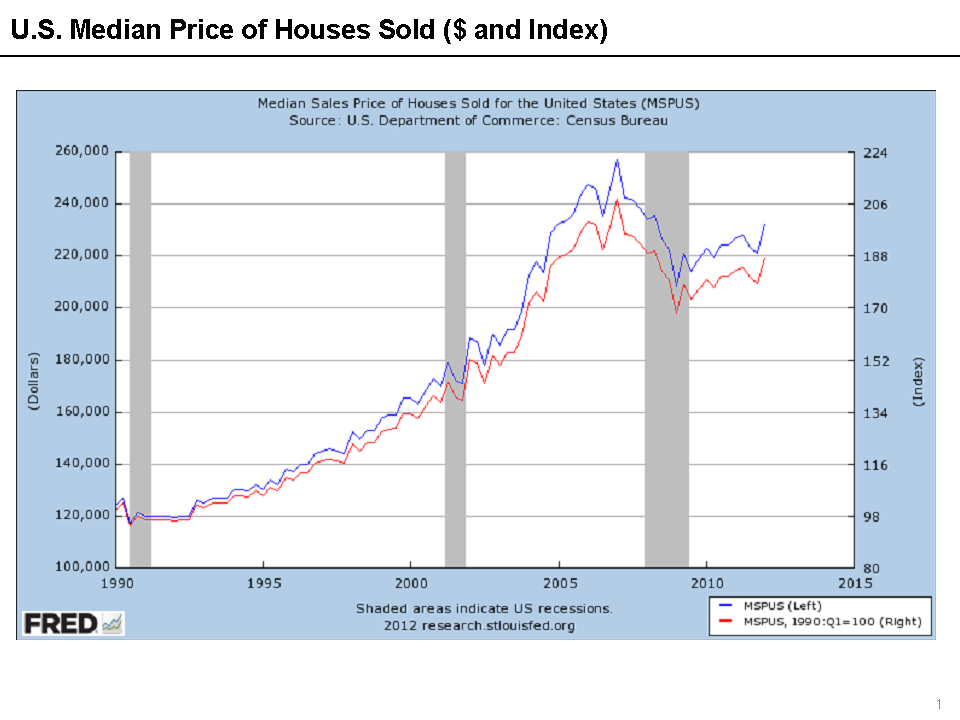
The chart on this page illustrates that cycle clearly. The 2008 downturn was sharp. The recovery after it was also sharp. That is the shape of real estate: slow in some years, fast in others, and never polite enough to promise a straight line.
Simple example
Imagine two investors who each buy a modest single-family rental for the same price. Investor A sells during the first stumble in the market because the property feels “stuck.” Investor B keeps reserves, fixes the roof before it becomes a crisis, and holds through the weak season. Five or ten years later, Investor B may have a larger equity base, more rent collected, and a much stronger refinance or sale position. The difference is not luck. It is time plus discipline.
What appreciation does not do
Appreciation is not a substitute for underwriting. A property that only works if the market bails it out is not an investment thesis. It is a hope with a mortgage attached. I prefer a baseline where the numbers still make sense if appreciation slows down for a while.
Practical rule: if the deal depends entirely on rapid price growth, I treat it as fragile until proven otherwise.
2. Passive income through rentals
The second major benefit is the one most investors can actually feel in the bank account: rental income. This is where real estate becomes more than an asset on a spreadsheet. It becomes a business with recurring receipts, recurring responsibilities, and recurring chances to make a mistake if you stop paying attention.
Why rental income matters
Rental income can help cover the mortgage, taxes, insurance, and maintenance while the owner builds equity in the background. That combination is powerful because the property may be doing three jobs at once: paying current costs, creating a stream of cash flow, and quietly increasing in value over time.
The IRS explains the basic framework in Publication 527. The point is simple and not very glamorous: keep your books clean, report your income, and track your expenses properly. Excitement is optional. Documentation is not.
Examples of rental property income
- Single-family rental: one tenant household, usually simpler management, but one vacancy can cut income to zero for the month.
- Duplex or triplex: multiple units under one roof, often a better balance between cash flow and management complexity.
- Small multifamily property: more income streams, but also more moving parts, which means the owner has to be more organized.
- Vacation rental: potentially higher revenue in some markets, but more turnover, more maintenance, and more local regulation risk.
| Property type | Income profile | Management burden | Main caution |
|---|---|---|---|
| Single-family rental | Usually steadier but smaller than a multi-unit property | Moderate | One vacancy matters more |
| Duplex | Two streams of rent under one asset | Moderate to higher | Shared systems can create shared headaches |
| Small multifamily | More rent sources and more scale | Higher | Bookkeeping and maintenance need discipline |
| REIT | Income through dividends rather than direct rent collection | Low | Market price volatility still applies |
How I judge rental income
I do not treat gross rent as the whole story. Gross rent is the headline. Net income is the truth. A property can look strong on a listing sheet and then quietly fail when insurance rises, a water heater dies, or a tenant turns over during the wrong season. That is why I prefer a reserve account and a conservative vacancy assumption. A property with no cushion is not passive income. It is a recurring reminder that old systems still need care.
Example of a healthy rental setup
Suppose a two-bedroom duplex brings in two separate rents. One tenant leaves, but the other remains. The property still generates some revenue while the owner repairs, re-lists, and screens the next tenant. That one detail can make the difference between a temporary setback and a financing problem. Multiple units do not eliminate risk. They distribute it.
Practical tip for new investors: build a one-year repair reserve before you celebrate the rent check. Roofs, appliances, and plumbing do not care about optimism.
3. Tax advantages
The tax side is where real estate often becomes more efficient than people expect. Not magically efficient. Not loophole efficient. Just structurally efficient when the records are clean and the property is held for the right purpose. This is also the part where careless assumptions get expensive, so I recommend a measured pace and a tax professional when the numbers become meaningful.
Common deductions
Rental owners can often deduct ordinary and necessary expenses tied to the property. That may include mortgage interest, property taxes, insurance, repairs, management fees, advertising, professional services, and some travel or mileage connected to the rental activity. Publication 527 is the right starting point if you want the federal rules in plain sight.
Depreciation is the quiet advantage many beginners overlook. Even when a building is holding value or rising, tax law may still let the owner recover part of the cost over time. That can reduce taxable rental income, which improves the after-tax return if the property is structured properly.
Repairs versus improvements
This distinction matters because not every expense is treated the same way. A repair keeps the property in working order. An improvement usually adds value, extends useful life, or adapts the property to a new use. The difference affects how and when the cost is recovered for tax purposes. This is one of those details that feels small until the tax bill shows up with a much bigger opinion.
- Repair example: fixing a leaking faucet or patching a damaged section of drywall.
- Improvement example: replacing an old roof or adding a new HVAC system.
1031 exchanges
If the strategy is to sell one investment property and roll into another, the IRS explains the basic rule in its like-kind exchange real estate tax tips. A properly executed 1031 exchange can postpone recognition of gain when the property is exchanged for qualifying replacement property. That is a serious tool, but it is also a procedural tool. Deadlines and documentation matter. People who “sort it out later” often discover later was too late.
A cautious example
Consider an investor who owns a rental house that has appreciated and now needs more active management than the owner wants. A 1031 exchange may let that investor move capital into a different property type or market without taking the full tax hit at that moment, provided the transaction follows the rules. That does not make the tax disappear. It changes the timing. Timing is often the whole game.
Tax discipline checklist
- Separate personal and rental expenses.
- Keep every receipt and invoice tied to the property.
- Track mileage or travel only when it is genuinely related to the rental.
- Document repairs and improvements separately.
- Ask a tax professional before you assume depreciation or exchange treatment.
Bottom line: tax advantages can improve the return, but they should support a good investment, not rescue a bad one.
4. Diversification of an investment portfolio
The fourth benefit is strategic. Real estate can give a portfolio something stocks and bonds do not always provide in the same way: a physical asset with its own income stream, its own local market, and its own behavior under stress. That does not make real estate immune to downturns. It makes it different. Different matters when the rest of the portfolio is already leaning in one direction.
Why diversification helps
When one asset class gets hit, another may hold up better. A well-balanced portfolio does not need every piece to perform the same job. In practice, that means a homeowner-investor with equity in property may not experience the same volatility as someone whose entire financial life sits in one stock index or one employer plan. It also means the investor has another lever to pull when conditions change.
The SEC’s Investor Bulletin on REITs explains one common way investors get real estate exposure without buying a building directly. REITs let investors share in real estate income while reducing the management burden of direct ownership. That is not the same as owning a duplex, but it can serve a useful role in a diversified plan.
Direct property versus REITs
| Option | Strength | Tradeoff | Best use case |
|---|---|---|---|
| Direct rental property | Control over the asset, leverage, and property-level decisions | Higher management effort and capital needs | Investor wants hands-on ownership |
| Public REIT | Liquidity and simplicity | Less control and market-price volatility | Investor wants real estate exposure without tenant calls |
| Broad stock and bond portfolio | Easy to rebalance and usually simple to hold | Less direct exposure to property income and local asset value | Investor wants high liquidity and broad market access |
Why this matters in the real world
I like real estate in a portfolio because it can behave like a stabilizer when used correctly. The property can produce rent, the mortgage can be reduced over time, and the underlying asset can appreciate. Those are three separate sources of return, and they do not all depend on the same market headline. But the tradeoff is also plain: concentration risk is real. If one property, one neighborhood, or one financing structure dominates your balance sheet, you are diversified in theory and exposed in practice.
Simple allocation example
A cautious investor might hold a mix like this: broad market funds for liquidity, a smaller REIT position for property exposure, and one direct rental property for control and long-term upside. That is only an example, not a prescription. The correct mix depends on cash reserves, debt tolerance, and how much operational work the investor is willing to do. Still, the principle stands: real estate should strengthen the portfolio, not crowd out every other asset class.
Practical rule: if a single property would break the whole plan, the plan is too fragile.
5. Long-term financial security
The final benefit is the one people usually mean when they say they want to “build wealth”: long-term financial security. I prefer that phrase because it is less theatrical and more useful. Security means more than account balance. It means breathing room. It means having an asset that can support retirement, education expenses, or a transition out of work on your terms instead of someone else’s deadline.
Real estate as an inflation-aware asset
Inflation can erode cash sitting idle. Real estate is not a perfect hedge, but it often has some inflation resistance because rent levels, replacement costs, and property values can all adjust over time. That does not make every building a shield. It does mean real estate can behave better than static cash in environments where costs keep creeping upward.
Long-term ownership also creates the opportunity to let debt work in reverse. As principal is paid down, equity rises. As equity rises, the owner may gain more flexibility to refinance, sell, or keep the asset and use it as part of a later plan. That is the quiet compounding effect people miss when they only stare at monthly rent.
What long-term ownership gives you
- Equity build-up: mortgage amortization gradually increases ownership stake.
- Potential price growth: appreciation can add to the equity base.
- Income durability: rent can continue even after the original purchase is long past.
- Planning optionality: the owner can sell, refinance, hold, or exchange the property.
Long-term versus short-term thinking
Short-term investors often ask whether they can get rich fast. Long-term investors ask whether the property can survive the ugly season. I trust the second question more. The market may reward patience, but patience only helps if the property itself is built to last. That means sensible leverage, enough reserves, documented maintenance, and a willingness to hold through slow periods when the numbers still make sense.
Case study: appreciation over a long cycle
Look at the historical curve in the chart above. The lesson is not that prices always rise. They do not. The lesson is that long-run owners who survived the weak years had the chance to benefit from the stronger years that followed. That is why I prefer to think in decades, not months. A property is not a lottery ticket. It is a system. Treat it like one.
Case study: income without direct management
For investors who want diversification but not tenant management, the SEC’s REIT bulletin is a useful reminder that real estate can be accessed in more than one form. A REIT may not provide the same control as direct ownership, but it can deliver property exposure and income participation without the same operational burden. That is a legitimate choice for some portfolios, especially when time is limited or cash for a down payment is not yet available.
Practical tips for new investors
This is the part I would hand to someone starting from zero. Keep it simple. Keep it conservative. Keep it documented.
- Buy the numbers, not the dream. If the property only looks good with optimistic rent and magical appreciation, walk away.
- Hold reserves. A repair fund is not a luxury. It is part of the business model.
- Use conservative vacancy assumptions. Even good properties go empty between tenants.
- Learn the local market before you buy. Neighborhood data matters more than generic national headlines.
- Track expenses from day one. Good records make tax season less messy and decisions less emotional.
- Know your exit before you enter. Decide whether you are holding, refinancing, exchanging, or selling.
- Do not over-leverage. Debt can amplify returns, but it can also magnify every bad assumption.
- Ask for professional help early. A short review with a lender, accountant, or real estate advisor can prevent expensive detours.
Some investors use a web app generator to prototype a simple rent, maintenance, and expense workflow before they commit to custom software. That is not a substitute for sound underwriting, but it can keep the records orderly.
If you want a broader sense of how property support fits into a normal service workflow, the services page is a useful next stop. If you want to understand the thinking behind this site and the way it approaches practical guidance, the about page is the right companion read.
Conclusion
Real estate can be a wise investment choice because it offers several benefits at once: possible appreciation, recurring income, tax advantages, portfolio diversification, and long-term financial security. The strength of the asset is not that it is perfect. The strength is that it gives disciplined owners multiple ways to win while still leaving them with something tangible they can inspect, maintain, and control.
I would keep the rule simple. If the property can perform on conservative numbers, then appreciation is upside, rental income is support, and tax treatment is a bonus. If it only works when every future year is ideal, it is fragile. Real estate rewards patience, reserves, and clear records. It does not reward denial.
Key takeaways:
- Real estate can appreciate over time, but the path is cyclical.
- Rental properties can create income if the numbers are underwritten conservatively.
- Tax benefits exist, but they depend on correct records and proper treatment.
- Real estate can diversify a portfolio and reduce dependence on one market.
- Long-term ownership can support financial security through equity and cash flow.
If you are considering your next step, verify the assumptions, review the local market, and build a reserve before you buy. That is the stable path. The dramatic path usually has a second bill attached.
Updated July 6, 2026 by Grant Vale.